



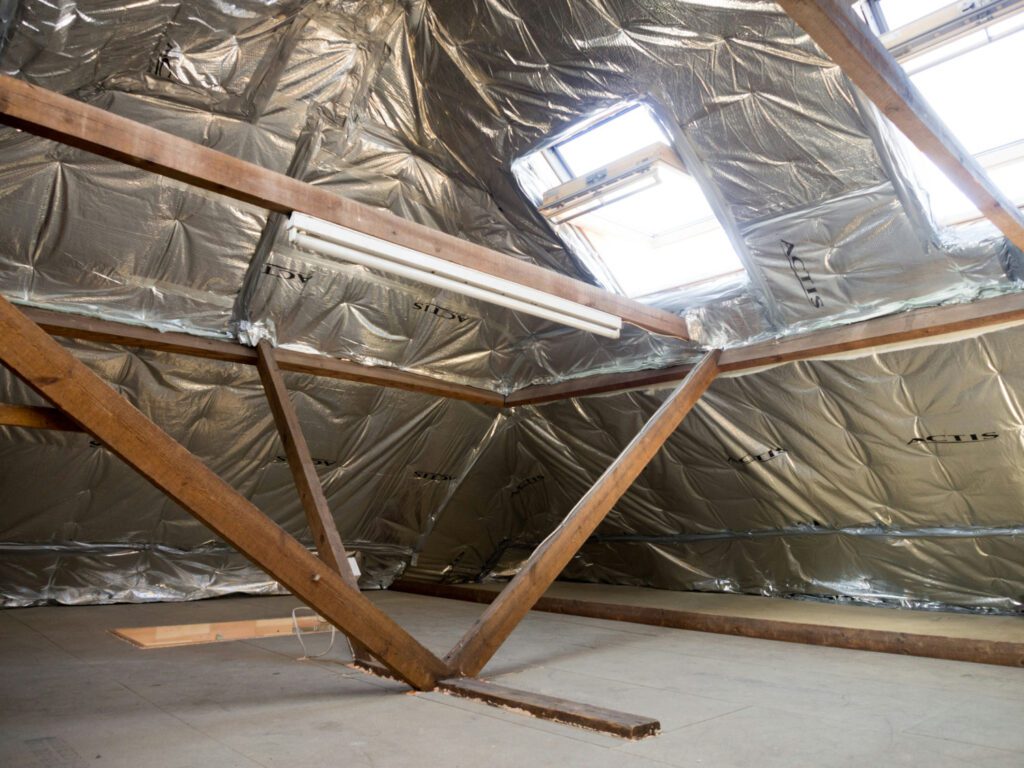
Does loft insulation improve EPC rating? Yes — and it’s usually the best place to start
If there’s one improvement we’d point almost any homeowner towards first, it’s loft insulation. It’s inexpensive, straightforward to fit, and it reliably improves an EPC rating — which is why it appears near the top of most EPC improvement reports. A home loses a significant amount of heat through the roof, so insulating the loft is one of the most cost-effective ways to keep that heat in and lift your score. As a Kent EPC assessment team, it’s the improvement we recommend most often, and one of the few we can recommend with very few caveats.
It also has an advantage the more headline-grabbing measures don’t: it helps under the current EPC rules and it’s central to the direction the rules are heading, where a home’s fabric — how well it holds heat — becomes a core part of the assessment. In other words, loft insulation is a safe bet now and for the future.
One quick point of clarity: loft insulation (sometimes called roof insulation) usually sits at ceiling level, laid between and over the joists — it’s the most common and most cost-effective type. Insulating along the roof rafters instead is a different, more involved job, typically done as part of a loft conversion. This page is about the standard loft insulation that most homes have or can easily add.
How much does loft insulation add to an EPC rating?
You’ll see figures quoted online — anywhere from a couple of points to fifteen — and the truth is it genuinely depends on your property: the size of the loft, the heating system, and, above all, how much insulation is already up there. The biggest gains come from going from little or no insulation up to a good depth. If your loft has nothing, or just a thin old layer, adding proper insulation can make a real difference to the rating.
The catch most people don’t know: more isn’t always better
Here’s something an honest assessor will tell you that an installer might not. Loft insulation gives you most of its benefit in the first stretch — the jump from nothing to a decent depth. After that, the improvement plateaus. The current recommended depth is around 270 to 300mm, and beyond that, adding more insulation barely moves the EPC rating at all.
So if your goal is purely to improve your EPC, there’s little point paying to pile insulation far above the recommended depth — the rating has already levelled off. We’ll tell you honestly where that point is for your property, so you spend money where it actually counts. (Insulation still saves on heating bills at greater depths, but the EPC benefit specifically tails off.)
The accuracy point that could improve your rating for free
This is where using an assessor who actually checks makes a real difference — and it’s the part we care about most. Loft insulation can only count towards your rating if the assessor sees it and records it correctly. When an assessor can’t, or doesn’t, get into the loft to measure the depth, the rules require them to fall back on an assumption — and that assumption is often conservative, or simply that there’s little to no insulation there.
We’ve seen certificates where the assessor assumed there was no roof insulation, when there was actually a good depth of it up there — the property was scored worse than it deserved, for no reason other than the loft not being checked. That’s points lost on paper for a home that had already done the work. A proper assessment — getting into the loft, measuring the real depth — can improve a rating with no building work at all, simply by recording the home accurately.
It’s exactly why we say the first step is always an accurate assessment. Before you spend a penny on improvements, it’s worth making sure your current rating reflects what’s genuinely there.
The specialist case: rooms in the roof
There’s one area where accurate assessment matters more than almost anywhere else on an EPC, and where a broad-brush approach can badly misrepresent a home: rooms in the roof. If your property has a converted loft — a room in the roof reached by a fixed staircase — how it’s assessed can make a real difference to your rating, and it’s genuinely specialist work under the current RdSAP 10 rules.
A room in the roof isn’t a single surface. It’s made up of several separate elements, each insulated differently and each assessed in its own right: the sloping ceilings that follow the line of the roof, the small vertical ‘stud’ walls at the sides, the flat ceiling across the top, and any gable walls. A thorough assessment looks at each of these, rather than treating the whole thing as one guess.
Here’s where it gets important for your rating. Under the rules, if there’s no access to a roof room and no documentary evidence of its insulation, an assessor has to assume it’s ‘as built’ — in other words, they can’t credit insulation that can’t be seen or evidenced. For an older conversion with no paperwork, that can mean the room is scored as poorly insulated even if it isn’t. On the other hand, where insulation details are known, or the real U-values can be established, those can be entered in place of the cautious defaults — which can improve the rating without any work being done.
This is also where building control records earn their keep. If building control holds a record of the loft being converted, we can use that date: if the conversion required insulation to meet the regulations of the time, RdSAP builds that in. But if there’s no record, or the room in the roof was original to the age of the building, insulation isn’t simply assumed — unless the whole property was built under more modern regulations. Knowing how to find and apply this evidence is the difference between a fair rating and a pessimistic one.
It’s detailed, time-consuming work — measuring and defining each element, checking building control, applying the right conventions — and it’s precisely the kind of thing a rushed or remote assessment gets wrong. For a home with a room in the roof, an accurate, properly evidenced assessment isn’t a nicety; it can be the difference between a rating that reflects the home and one that penalises it for missing paperwork.
Loft insulation, landlords and 2030
For landlords, loft insulation is often the single most important first move towards compliance. With the minimum EPC standard for rented homes set to rise to band C by 2030, and the reformed rules placing fabric performance — how well the building holds heat — at the heart of the assessment, insulation is no longer optional. Many rental homes currently sitting at D or E fall short largely because of inadequate insulation. Loft insulation alone won’t always get a property to C, but it’s almost always part of the plan, and it’s the most cost-effective first step
Grants and support for loft insulation
Loft insulation is one of the measures most commonly covered by government support, though what you can access depends on your circumstances:
As with all these schemes, eligibility and dates change, and the support is delivered through an accredited installer. We work with trusted local and national installers, and the sensible first step is a conversation with us about your EPC — we’ll explain what’s realistic for your property and point you the right way.
Talk to us first — start with an accurate rating
Because so much of loft insulation’s EPC value comes down to what’s already there and whether it’s been recorded accurately, the best first step is a conversation. We can look up your existing EPC — even an old or inaccurate one is a useful starting point — and, ideally, carry out an accurate assessment to establish what your rating genuinely is right now. From there we can tell you honestly whether loft insulation would help, how much, and whether you’d benefit from combining it with other measures.
It’s a simple, honest process: we assess your home accurately (a draft EPC gives a reliable baseline), tell you where the worthwhile gains are, and — where insulation work makes sense — point you towards an accredited installer we rate. We don’t sell insulation, so our only interest is getting your rating right.
So, is loft insulation worth it?
For most homes, yes — it’s one of the most reliable, cost-effective ways to improve an EPC rating, it helps now and under the rules that are coming, and it may be grant-funded. Just make sure two things are true: that you insulate to the recommended depth rather than beyond the point of diminishing returns, and that your loft is assessed accurately so you get full credit for what’s there. We can help with both.
We cover homes across East Kent. Call us on 01304 626457, request a draft EPC for an accurate baseline, or get in touch to talk through what loft insulation could do for your rating.